– dan kellar Waterloo, ON – As municipal elections are starting to heat up across the province, a new local organisation is promoting local democracy by helping to inform and educate Waterloo Region residents on all aspects of the vote.
This show features an interview with Alex Latta, a professor at Wilfrid Laurier University and a spokesperson for VisionWR who told CKMS News “We really believe in local democracy and holding politicians to account… and [we want] others in our communities to feel empowered to participate.”
Since starting their work last year, the group has hosted open meetings, run workshops, created toolkits, developed the vision statements, and has now launched the 2026 regional and municipal elections candidate and voter engagement hub.
According to a recent press release “VisionWR, is a new grassroots volunteer organization dedicated to promoting education, dialogue, and debate on the issues that will shape our shared future: climate change, housing, transportation, water, biodiversity, food security, well being and local democracy.”
To explore the 2026 regional and municipal elections candidate and voter engagement hub, visit VisionWR.org
by: Shalaka Jadhav
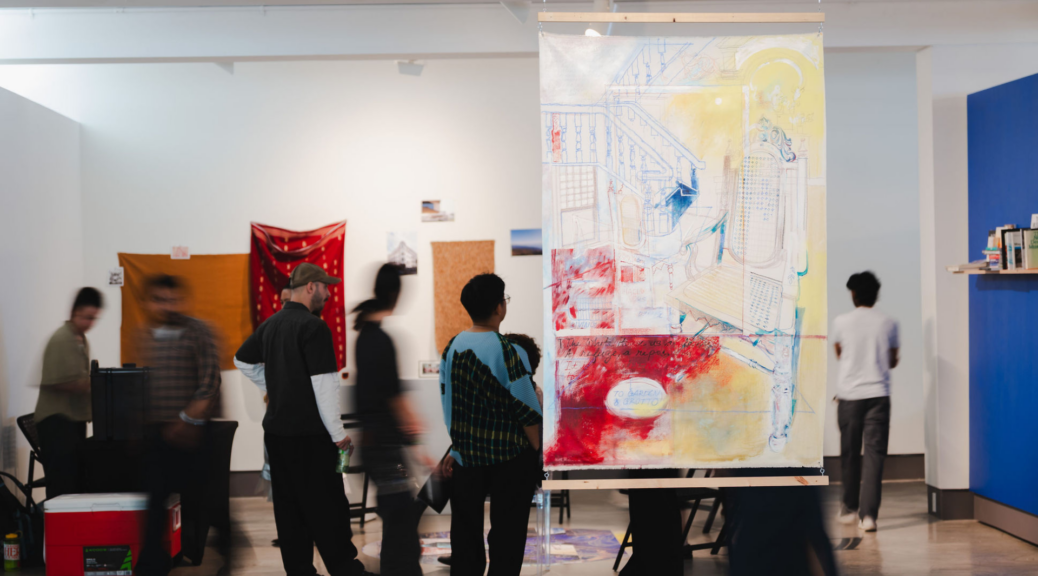
CAMBRIDGE, ON – Hosted at the University of Waterloo Cambridge Architecture Campus, “A Room of One’s Home” is an exhibition curated by Bianca Weeko Martin, and brings together the work of six Waterloo Architecture graduates and alumni whose research reflects on relationships between architecture, diaspora, memory, and cultural knowledge.
Employing drawings, publications, artifacts, and architectural research, the exhibition invites visitors into rooms where, through architectural inquiry, “home” can be understood as an evolving relationship across generations.
The exhibition and its artists covers several regions:
Ricardo Espinoza, the Caribbean Sea;
Hyjnid (Nidi) Metaj, Albania;
Angeline Reyes, the Philippines;
Giulia Simonetta, Italy;
Zaven Titizian, Syria/Lebanon, and;
Hiba Hasan Zubairi, the Indus River Basin.
Today I’m speaking with Bianca Weeko Martin, curator of “A Room of One’s Home.”
Bianca Weeko Martin is a writer and researcher weaving together architectural practice with theory and personal narrative. She is the author of the “Architectural Guide: Manila” and writes about art, space, and the Filipino diaspora for cultural institutions and publications. She recently made the 2026 CBC Nonfiction Prize longlist for her work “Tita Tallulah”.
“A Room of One’s Home” is on until October 1, 2026. Join Bianca to celebrate the exhibition closing, on September 24, between 5-8pm at the Riverside Gallery. At the closing, exhibiting artist Ricardo Espinoza will be leading a fabric transfer workshop.
This program is a part of the Local Journalism Initiative and is funded by the Community Radio Fund of Canada, Heritage Canada, and the CKMS Newsroom.
You can access archived versions of this program at radiowaterloo.ca/news, and listen to all the Local Journalism Initiative content at frequencynews.ca
If you want to get in touch with comments, or ideas about stories to cover, email us at news@radiowaterloo.ca
The theme music on today’s show was “Polyvinyl” by Anemoia, courtesy of the Free Music Archive, under the Creative Commons Attribution License. You can find it at the Free Music Archive—freemusicarchive.org
by: Shalaka Jadhav
CAMBRIDGE, ON – The Long Dash Festival is a free, two-day event running between July 25 and 26, exploring the creative intersections between art and science. Hosted at rare Charitable Research Reserve in Cambridge, Ontario, and co-presented by Musagetes, the festival takes its name from the Long Dash Skipper, a brown and orange butterfly found in grassy habitats, including at the site of the festival.
In this segment, I’ll be in conversation with Elwood Jimmy, Indigenous Programs Curator at Musagetes, who highlights how Indigenous knowledge systems and ways of relating to the land inform the approach to programming the festival, and how the festival being sited at rare Charitable Research Reserve has helped shape the experience of the festival over the last three years.
In this conversation, Jimmy mentions Elder Peter Schuler, Elder of the Mississaugas of the Credit First Nation of the Anishnaabek Peoples. His collection of literary works, “The Sound of the Homeland Drum” was launched at the ArtsEverywhere Festival in Guelph in May 2026 through the Indigenous Otherwise Program, and printed by Publication Studio Guelph, both supported by the Musagetes Foundation. Learn more at publicationstudio.biz/books/the-sound-of-the-homeland-drum/.
The Long Dash Festival is free to attend, and listeners can find the full schedule and learn more about the festival at longdashfestival.ca.
Photo Credit: Illustration by Cai Sepulis courtesy of the Long Dash Festival
—
This program is a part of the Local Journalism Initiative and is funded by the Community Radio Fund of Canada, Heritage Canada, and the CKMS Newsroom.
You can access archived versions of this program at radiowaterloo.ca/news, and listen to all the Local Journalism Initiative content at frequencynews.ca
If you want to get in touch with comments, or ideas about stories to cover, email us at news@radiowaterloo.ca
The theme music on today’s show was “Polyvinyl” by Anemoia, courtesy of the Free Music Archive, under the Creative Commons Attribution License. You can find it at the Free Music Archive—freemusicarchive.org
The federal government has announced over $96 million in contributions and loans aimed at affordable housing across South Central Ontario, including Waterloo Region.
Locally, the funding amounts to $25 million which will help create 336 new affordable homes and repair more than 7,300 homes in the region.
The announcement was made at an affordable housing construction site in Kitchener on Thursday. The event was attended by political representatives, including Kitchener Mayor Berry Vrbanovic, Regional Coun. Colleen James, and the Minister of Families, Children and Social Development of Canada Jenna Sudds, who made the announcement on behalf of Sean Fraser, Minister of Housing, Infrastructure and Communities.
After 56 days, the pro-Palestinian encampment at the University of Waterloo has been peacefully dismantled. The university agreed to drop a legal claim and injunction proceeding in exchange for the voluntary decamping.
The encampment members criticized what they called the university’s anti-free speech strategies, including surveillance and intimidation, and emphasized their resolve to keep fighting for divestment from Israel.
Arts institutions in Kitchener are struggling, and the city is pinning it on inequities in the Federal regional arts funding model. City Council noted that Kitchener receives five times less in arts funding than larger cities like Montreal and Winnipeg. In response, they passed a motion requesting the federal government to address these disparities.
City Councillor Dave Schnider highlighted the significant funding cuts by the federal government and how this impacts local arts organizations.
While the motion was supported unanimously by council members, Mayor Berry Vrbanovic suggested also seeking additional support from the provincial government.
Summer hiking season is back, and along with it, warnings to be on the lookout for ticks.
At Waterloo Regional Council on June 19, the Waterloo Region Public Health Department warned residents of the increased presence of black-legged ticks in the area. A black-legged tick bite can transmit Lyme disease and other tick-borne illnesses.
Dr. Adele Chang, the Region’s Associate Medical Officer for Health describes the detection of these ticks in Cambridge and that three additional tick-borne diseases — anaplasmosis; babesiosis; and Powassan virus disease, have been added to the provincial list of diseases of concern.
Bolstering Dr. Chang’s warning, the eTick website reports a doubling of tick sightings in the area.
Alongside these warnings comes advice on how to prevent tick bites in the first place. Rebecca Piavison the Public Health Manager for Vector-Borne Diseases at the Region of Waterloo, provides practical tick tips, emphasizing the importance of physical barriers, insect repellents, and thorough body checks after outdoor activities.
Waterloo Region residents have been vindicated by a simple phone app after a complicated computer noise model failed to recognize real-life noise.
Staff used a phone app to assess the noise and determined that vehicles with modified mufflers are to blame.
At a Waterloo Region Council meeting in early June, Kitchener residents living near Highland Road West, raised concerns about noise following the expansion of Highland Road. At that time, Council requested information and staff presented their findings at the Regional Council meeting on June 19.
Doug Spooner, the Acting Commissioner of Transportation Services for the Region, reported back to Council, explaining he went to the impacted neighbourhood and tested the noise with an app on his phone.
Spooner discovered excessive noise caused by disruptive peak noises generated by vehicles with modified mufflers or exhausts and recommended regulatory measures.
The Willow River Centre in Kitchener is advocating for more meaningful support for Indigenous people and culture instead of what they characterize as routine performative gestures from municipalities and organizations.
The Center, which serves Indigenous, racialized, Two Spirit, and LGBTQ youth, is hosting Summer Solstice Saturday on June 22nd to celebrate National Indigenous Peoples Month. The Willow River Centre co-directors Amy Smoke and Bangishimo said that their past efforts on the day have often resulted in overwork and stress.
“It’s been so many years now since the TRC calls to actions came out and still to this day for a lot of organizations and spaces, we’re still considering an afterthought where, where we get emails like the week of before June and these organizations and corporations are looking for somebody to sing and dance for them,” Bangishimo told CKMS News.
The Summer Solstice Saturday will be held on Saturday, June 22nd at the Kitchener Farmer’s Market from 8 a.m. until 2 p.m.
The recent expansion of Highland Road West in Kitchener has increased noise pollution, significantly impacting residents who live along the road between Ira Needles Boulevard and Fisher Hallman Road.
Despite residents’ complaints and self-initiated noise-blocking measures, Regional staff insist the levels in this area do not exceed thresholds. Staff have said they will continue to rely on theoretical models that predict noise levels and that live noise tests are not routine due to precedent, policy and budget constraints. The residents, on the other hand, argue that the models are flawed and real-time noise data and live noise studies would provide a more accurate reflection of the situation.
Regional Councillors asked questions of both sides, eventually agreeing to draw up a motion to conduct live measurements in the impacted neighbourhood, with further discussions planned for the next Regional Council meeting.
Waterloo Region Health Coalition has called for the Ontario government to hold a public vote on healthcare privatization in Ontario.
Jim Stewart of the Health Care Advocacy Group criticized the government’s privatization agenda, and the lack of clear communication both during the 2022 election and since, arguing privatization lacks public support and undermines the public system.
The Ontario Health Coalition highlights significant underfunding of public hospitals by the Ford administration, leading to increased wait times and operational challenges.
While Kitchener Conestoga MPP Mike Harris, Jr. defended the government’s health care spending (but provided no citations for his claims), Kitchener Centre MPP Aislinn Clancy argued the government has been underfunding the system, ultimately increasing the costs for taxpayers and creating a two-tier system.
After gathering community input, the City of Waterloo has modified its plan to develop vacant city land near Rim Park.
Michelle Lee, an Executive Officer at the City of Waterloo, highlighted how the idea of increasing building heights from 6 storeys to 12. The push for more commercial units came from the community.
The project aims to provide over 700 homes in a sustainable, affordable neighbourhood with commercial opportunities. The city has submitted the modified plan and now waits for approval for the Minister’s Zoning Order (MZO). An MZO authorizes the Minister of Municipal Affairs to fast track zoning changes on specific pieces of land.
Financial structure and long-term affordability remain critical questions still to be resolved. Staff favour land lease models, where land remains in community ownership but is leased to developers, while Sean Campbell, the Executive Director of Union Sustainable Development Cooperative, cautioned against prioritizing land leases over other potential models, highlighting that the core objective is perpetual affordability and public benefit.
As Regional schools prepare for their final month of the school year, the Waterloo Region Department of Public Health reported to Council on May 23 that over 37,000 immunization records have been updated for school students since January, preventing student suspensions.
Dr. Hsiu-Li Wang, the Chief Medical Officer of Health for the region, provided an update on the enforcement of the Immunization of School Pupils Act. While Dr Wang discussed the suspension of some students due to their outdated records, she also noted the Region’s high compliance rate, particularly for measles immunization, with no local cases reported.
A full compliance report will be provided in the fall.
Kitchener City Council is addressing the issue of excessive road signs to combat clutter and visual pollution on city roads by changing its sign bylaws.
The changes are meant to discourage the use of roadways for marketing purposes. Only special event directional signs, such as signs advertising open houses and portable signs for new home developments, are allowed on city boulevards.
Key revisions to the sign bylaw include regulations on the timing and duration of sign placements, mandatory inclusion of dates on signs, the relaxation of distance requirements from buildings for certain signs, and the removal of the City’s 30-day sign hold provision.
City of Kitchener Councillor Paul Singh and the city’s Coordinator for Planning and Zoning Services, Joanne McCallum, emphasized that in addition to cleaning up the roadsides, the new regulations will help city staff police these nuisance signs.
People out for their daily walks in the Waterloo Region may have noticed a tall plant with the clusters of white flowers. It’s the garlic mustard plant — and it’s invasive, destructive, and spreading.
Garlic mustard may not be the most egregious of the invasive species, but it is the most widespread. The plant spreads quickly through seed dispersal and dense stands of garlic mustard can produce more than 60,000 seeds per square meter and can double in size every four years.
Ron Wu Winter of the Grand River Conservation Authority describes Garlic mustard’s spread, the challenges it poses for removal and control, and its ability to release chemicals that inhibit the growth of native plants.
Pedestrians and cyclists in Kitchener are at a disproportionately high risk of serious injury or fatality due to aggressive and inattentive driving, according to the latest City of Kitchener Vision Zero Annual Update Report.
This year’s report update was presented at the City of Kitchener’s Community and Infrastructure Services Committee meeting on Monday, May 13th. Adopted in 2021, the Vision Zero strategy aims to eliminate severe injuries and fatalities on Kitchener’s roads, with the 2024 report outlining over 40 action items for street safety improvements. The report highlights the problems of aggressive driving behaviours and the inadequacy of road designs to ensure the safety of vulnerable road users.
Delegates to Council discussed lowering speed limits, increasing the number of traffic cameras, and implementing infrastructure changes as potential solutions. Other delegates detailed the successes they have found in educating young students on road safety and encouraging alternative modes of transport.
To commemorate its 40th anniversary, the only independent bookstore in Waterloo, Wordsworth Books, has revived the Wordsworthy Literary Award. The award, presented for the first time in several years, recognizes outstanding literary contributions from Canadian authors and is intertwined with the bookstore’s history.
One of the owners of Wordsworth Books, Mandy Brouse, explains why the award has been revived and how it connects with the store’s history. Over the past 40 years, Wordsworth Books has weathered the challenges to its business, including recessions, the ION LRT construction, and the COVID-19 pandemic, thanks to the loyalty of its customer base.
The winner of the 2024 Wordsworthy Literary Award will be announced at 1 p.m. on Saturday, May 11 at the store’s Uptown Waterloo location.
The impacts of being hit by a car can be serious and the increased size of vehicles can contribute to more severe injuries. While attempts to increase driver accountability have so far failed at Queen’s Park, police have trained their focus on preventative measures and awareness to improve road safety.
The show features an interview with Waterloo Regional Police Services staff sergeant Scott Griffiths and insights from Janice Jim, the chair of the City of Waterloo Active Transportation Committee and vice president of CycleWR.
A few years ago, it was common for car windshields to be spattered with bugs after a drive in the country. According to Jennifer Leat of the Pollinator Roadsides Project, that’s not happening so much anymore. There are fewer bugs, and fewer bugs equals fewer pollinators.
A community driven project to help pollinators will be happening on Saturday April 13 to restore habitat corridors for pollinators by planting pollinator-friendly native plants along roadsides.
Backed by a grant from the Region of Waterloo’s Community Environment Fund with support from volunteers and sponsors, the Pollinator Roadside Project seeks to increase biodiversity, support pollinator conservation, reduce maintenance costs, and control water runoff. The project also hopes to set a provincial and national precedent for prioritizing sustainability in roadside plantings.
Jennifer Leat, Lead of the Pollinator Roadsides project talks to CKMS about the project and the importance of pollinators.
Lyme disease, a combination of skin rashes, fevers, headaches, and fatigue, is contracted from black legged ticks, and if left untreated, can escalate to affect joints, the heart, and nervous system.
ETick.ca is an online platform where people voluntarily report tick sightings in the environment or when found on humans or animals. Comparing the first three months of 2023 to 2024 shows there has been a threefold increase in blacklegged tick reports for KW on eTick.ca.
The Region of Waterloo’s Public Health Manager for Vector-borne Diseases is Rebecca Piovesan, and she talked to CKMS News about lyme disease and back-legged ticks.
These numbers are from the Food Bank of Waterloo Region and they highlight the surge in demand for food and the growing issue of food insecurity within our community.
However, amidst these challenges, there are stories of hope and compassion emerging through community-led initiatives that are making a difference in the lives of those in need.
These initiatives include the Tiny Home Takeout and Food Not Bombs, which are both operating on shoestring budgets with a crew of volunteers and demonstrate the power of grassroots movements in addressing basic human needs.
A group of local Irish community members is asking the public to support and advocate for Palestinians this St Patrick’s Day. The group hopes to draw attention to the current deteriorating situation in Palestine.
Justine Rogers Basan, an organizer of the event, explains how the day will highlight the genocide in Gaza and the historical solidarity between the Irish and Palestinian people and draw parallels between the oppression experienced by both communities. The organizers of the event have called for a ceasefire, a Canadian arms embargo, and an end to the occupation in Palestine.
“No St. Patrick’s Day during Genocide” will take place at Waterloo Town Square on March 17 at 11 am.
St. Patrick’s Day is coming up — and with it, a whole bunch of stereotypes about Irish culture. The organizers of the Irish Real Life Festival in Kitchener wants to move beyond the usual narrative towards a deeper understanding of Irish culture in the broader world.
The Festival kicked off last weekend in Kitchener amidst local and international tensions. Organizers of the Irish Life Festival spoke with CKMS News about how they are working to expand people’s understanding of the Irish story by, if not detaching it from the association with heavy drinking, at least showcasing another side of Irish culture.
Within this year’s program, various events draw on Irish storytelling, spirituality and history to demonstrate similarities between different cultures and how, even in the face of war, peace is possible.
High patient volumes and staffing shortages within local hospital emergency rooms are impacting the ability of local paramedics in the Waterloo Region to respond to critical calls.
The preliminary Paramedic Services Annual Report was presented to the Community and Health Services Committee at Regional Council (item 8.2 on the regular agenda) this week reporting response statistics, off-load delay mitigation, and changes to the categorization of system alerts and patient acuity.
Although call volumes requesting paramedic help increased only by 1% in 2023, in 2022 call volumes increased by 11% over the previous year, and the paramedic service is still adjusting to these high call volumes.
While the local paramedic service exceeded all of their provincial and regional response time targets, the challenges posed by off-load delays, which happen when paramedics are held up in hospital emergency departments waiting for patients to be transferred to the care of a hospital, are a significant factor in response time.
Early Wednesday (Feb. 28), about 50 demonstrators in Kitchener blocked the entrance to local arms manufacturer Colt Canada on Wilson Avenue, demanding that the Canadian government impose an immediate and total arms embargo on Israel.
The demonstration is part of a broader protest across the country which is demanding a Canadian arms embargo on Israel and highlighting military exports from Canada to Israel. It was organized by Labour 4 Palestine, Labour Against the Arms Trade, and World BEYOND War, in response to the call by a coalition of more than 30 Palestinian unions and worker organizations to end all complicity and stop the flow of weapons to Israel.