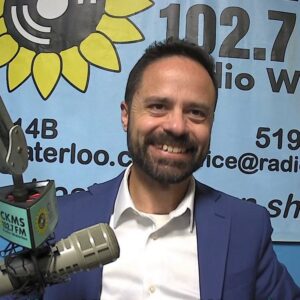
Geoffrey Horsman Geoffrey Horsman, Waterloo candidate for WRDSB Trustee, spoke with Bob Jonkman on Wednesday 21 October 2026 about the issues for the 2026 municipal election.
The views expressed in this program are not necessarily those of the Radio Waterloo Board of Directors, volunteers, sponsors, or advertisers.
All Regional Council candidates, including Mayoralty candidates in Waterloo Region were invited by e-mail, the candidate’s online contact form, or on social media. Some have declined to participate, others have not responded.
World Literacy Day on September 8 coincides with the first week of school under the Ontario provincial government’s new Better Schools and Student Outcomes Act, which was passed in June of this year. This new education act overhauls what came before. It broadens the minister’s powers and among other things increases reporting requirements, provides more supports for literacy education, and allows for major changes to the language curriculum
Literacy is more complex than just knowing how to read and write, The Organization of Economic Co-operation and Development (OECD) defines literacy as “the ability to understand, evaluate, use and engage with written texts to participate in society.”
Statistics Canada defines it as “the ability to use and understand information that is fundamental to daily life at work, at home, and in the community.”
In Canada, literacy is measured with a 5-level scale, 5 being the highest and 1 being the lowest. If a person functions only at lower levels, they may be considered to have problems with literacy.
In the International Assessment of Adult Competencies survey, the OECD found that 49% of Canadians (aged 25 to 65), scored at or below level 2 for literacy and 55% also scored at or below level 2 for numeracy on the 5-level scale. Level 3 is the threshold required to compete in a knowledge-based economy.
In February 2022, the Ontario Human Rights Commission released the ‘Right to Read‘ report, which found, among other problems that one-third of students graduate school without attaining the level of literacy that the OECD deems necessary to function fully in today’s economy.
The Waterloo Region District School Board serves more than 64,000 students in more than 121 schools. In 2018 to 2019, only 70 per cent of WRDSB students were meeting the provincial standards for reading proficiency, according to data from the Education Quality and Accountability Office (EQAO). There are explanations for this. Historically, local students have typically lagged when compared to students in other areas of Ontario. In a November 2022 article about dropout rates, Jeff Outhit in the Record noted that in times past in this Region, people used to be able to support families by relying on good-paying factory jobs that did not need much education. Outhit notes that more than 10,000 of these factory jobs have disappeared since 2006.
In the fall of the 2021, WRDSB released a multi-year structured literacy plan. Within a year, in October 2022, local grade 10 students taking the Ontario literacy test beat the provincial average by three percentage points with 85 percent of students in the wrdsb meeting or surpassing the provincial standard. Literacy levels in the Region have risen a full 15 points to 85%. Scott Miller, assistant director of the WRDSB explains how this was achieved.
But what about those people who left school before the recent focus on increasing literacy? They may have left school 2 years ago or forty years ago.
Jane Teur of Project Read Literacy Network explains what this looks like, misconceptions about the people who fall below the literacy line, the Ontario government’s return to phonics in language curriculum, and the gaps in the system.
Regardless, WRDSB says they are ready and explain how they’ve prepared.
The music on today’s show is called “Maple Music” by Godmode courtesy of by Expectantly Maple Music on YouTube.
This program is a part of the “Local Journalism Initiative” and is funded by the Community Radio Fund of Canada, Heritage Canada, and the CKMS Newsroom.
Food inflation cheques from the federal government arrive in local mailboxesMonths after Parliament passed the one-time benefit first unveiled as part of the 2023 federal budget, the payment was distributed on Wednesday.The food-inflation focused affordability measure is set to roll out to approximately 11 million low- and modest-income Canadians, and over 100,000 people in Kitchener. The Parliamentary Secretary to the Minister of Revenue Peter Fragiskatos came to Kitchener to explain the rebate and answer questionsFor more information on the grocery rebate, you can contact the CRA or go to their website at: https://www.canada.ca/en/revenue-agency/services/child-family-benefits/goods-services-tax-harmonized-sales-tax-gst-hst-credit/grocery-rebate.html
Also in headlines for July 11, 2023:
Queen Victoria statue in Kitchener’s Willow River Park vandalized for sixth time in three years
Two new WRDSB trustees appointed, including son of late trustee
Council approves construction of over 5000 residential units and more are on the way
Laura Mae Lindo, outgoing MPP for Kitchener Centre, endorses Debbie Chapman in the race for MPP.
The music on today’s show is called “Reggae Music Upbeat Chilled Happy Island | EASY JAM” and it’s by We Have A Tripod. This work is licensed under a Creative Commons Attribution License.
This program is a part of the “Local Journalism Initiative” and is funded by the Community Radio Fund of Canada, Heritage Canada, and the CKMS Newsroom.



 Creative Commons Attribution 4.0 International License. You are free to use this material, as long as you credit “Radio Waterloo” with a link back to this page.


