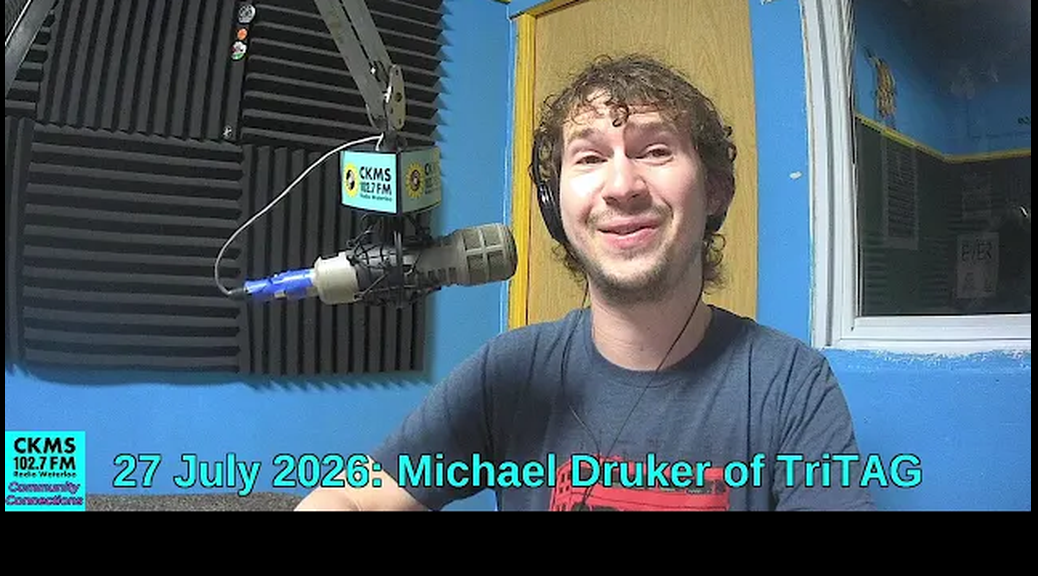
Michael Druker of TriTAG joins Bob Jonkman to talk about all things transport, traffic, and transit. Michael tells Bob about the history and the work that TriTAG does, how TriTAG performs its advocacy, some interesting details on the Light Rail Transit project and Phase Two now being built to Cambridge, how Phase Two can avoid the pitfalls of transit projects in other cities, other projects of TriTAG like the Frequent Transit Network, and the resources available on the TriTAG website.
Michael Druker introduces TriTAG, a local organization that’s been around since 2009, that’s all about people being able to more easily walk, bike, and take transit in Waterloo Region. The advocacy takes place through events, info tables at events, but the focus is on the website, the newsletter, news roundups, and the deep dives they do on policy topics and advocacy focus. There will be an election questionnaire for the upcoming municipal election. Sometimes TriTAG presents at municipal councils, and will sometimes reach out to staff or politicians, but mostly they encourage the public to get in touch with their elected officials.
6m50s
Right now the City of Kitchener is working on their Mobility Master Plan, something where more public input can really make a difference in what gets prioritized. It’s possible to be invested in a policy that’s just not possible due to, for example, budget constraints. Providing positive feedback as well as negative is very valuable; positive voices is something staff and politicians will listen to; they like to know their efforts are appreciated. But it’s easy to take things for granted when they are going well. Is it social media that’s responsible for negativity with council projects? Not just transport but housing and finance. TriTAG can offer a balanced view. It’s not useful to despair or not despair based on the social media algorithms. Michael has not seen a trend, either positive or negative, driven by social media. There are things that capture people’s imagination, in a way that other things don’t, even though they’re important. It depends on how much work is put into public engagement.
12m11s
Introduction to Cold Shoulder by Awake & Dreaming.
Does TriTAG reach out to the province on provincial transporation issues? Not really, most of their advocacy is local.
16m48s
Michael gives some of the history of TriTAG, starting in 2009 with the “Waterloo Region Rapid Transit Project.” Even then, the vision of TriTAG was to give people a choice is choosing their mode of transport: Walking, biking, transit. The issues even extend to land use. TriTAG lost some steam after Light Rail Transit was established in Waterloo Region, but it is now getting a fresh start. Even if transport issues appeas completely solved, there will still be a role for TriTAG. Bases on past performance, there will be lots to do in the future. Even now, there is an approved project for Phase Two of the LRT to Cambridge.
21m30s
The LRT was planned in two phases, there was no way that the entire project could have been funded in one phase. But now that Phase One is done, it does what it was designed to do, and people like it. This matters to people, who want to live next to the LRT. Now we need to bring this to Cambridge, but why stop there? One of the themes in the transit world is the cost of transit construction. When the LRT was proposed, it seemed like a really expensive project, but that was because it seemed unproven. Now that it does work, the cost on a comparative scale was pretty low. That’s not the case in other areas (Toronto’s Eglinton Crosstown LRT, Finch West LRT), and there are knowable reasons for why that happened. We want to take better charge of those reasons when we build Phase Two to Cambridge. If we build cost-effectively, then we can build even more transit infrastructure.
25m56s
What’s the resistance to Phase Two of the LRT? The project is approved, there’s an approved route, although there are some land use questions. Today, the actual barrier is funding — the Region of Waterloo is seeking upper level funding. Bob has heard that costs for Phase Two have ballooned; Michael says that cost estimates have ballooned. The cost estimates have gone up, in part from using the same poor cost practices used in the Toronto LRT projects. But we don’t have to follow the lead of those projects, we can follow the lead of Phase One and build it more cost-effectively. TriTAG hopes that funding can be used for programs that are more than just Phase Two. If we keep building, build in stages, build as we build other infrastructgure, then we keep the knowledge of how to build transit. Michael thinks that the main start will probably be delayed until after the municipal election, but there are other small projects that have prepared for LRT construction.
Other projects TriTAG is working on: “Frequent Transit Network”, already in the business plan for Grand River Transit. Frequent transit is a game changer, at 10-15 minute frequency the service changes qualitatively, people don’t have to allocate time for route planning and waiting for transfers. There are already some frequent routes, the challenge is to add frequency on other routes and to make it consistent, on evenings and weekends. TriTAG has just written an article: Why GRT needs a Frequent Transit Network. People already understand frequent transit from other cities and subway systems. Some people in rural areas would be happy with any transit service at all. Frequent service should be cheap and simple, no additional infrastructure is required, no additional ticketing systems, no new bus stops, only some extra buses and operators. Michael says some routes are already doing frequent service at busy times, although additional bus service will require more maintenance and may wear out the buses faster. But the GRT fleet is fairly new, Michael says buses have a service life of about 14 years. Bob has lived in places where the buses were 20 years old.
44m12s
Talking about the things available on the TriTAG website https://www.tritag.ca/: Newsletters, a weekly news roundup with mobility news, walking, biking, transit, and land use, highlighting what people can get involved in, consultations, feedback, events, plus there are analysis posts, and a series on LRT expansion called IONize Waterloo Region. People can subscribe to the newsletter and news roundup, and follow on the TriTAG social media accounts. Bob mentions an article Kitchener to Stratford by Transit. Michael lists a few other good articles, and reminds us of the upcoming muncipal election.
46m10s
Bob thanks Michael and gives the end credits.
CKMS Community Connections airs on CKMS-FM 102.7 from 3:00pm to 4:00pm on Mondays.



 Subscribe to the CKMS Community Connections podcast!
 See all CKMS Community Connections shows!
 Creative Commons Attribution Only license. Copy, re-use, and derivative works are allowed with attribution to Radio Waterloo and a link to this page. Music selections are copyright by the respective rights holders. The theme music is written and performed by Steven Todd.