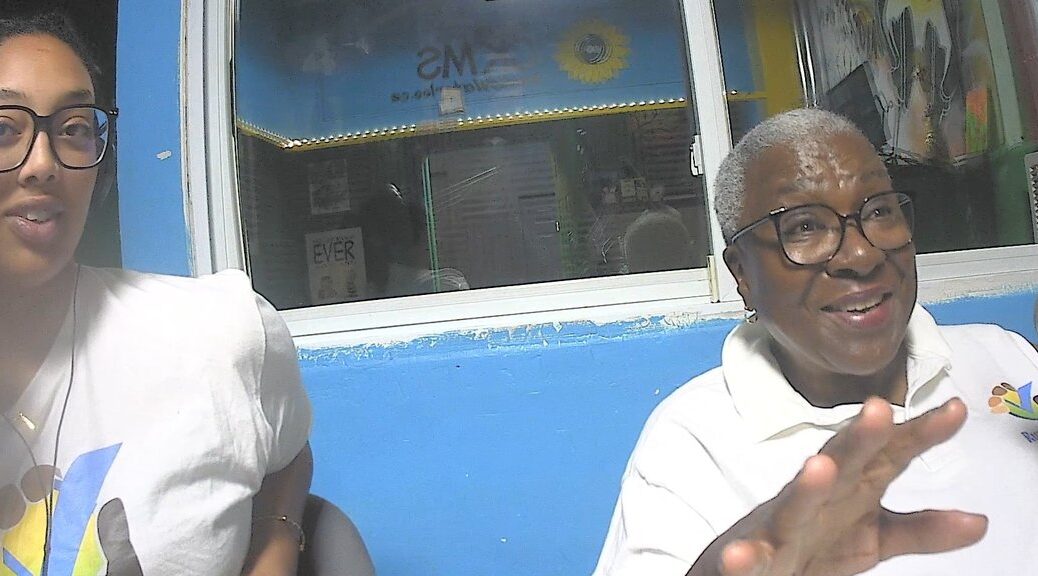
Lulia Habtemicheal and Marcia Smellie of Run4OfficeWR talk to Bob Jonkman about getting people to run for office by getting them out to vote, and fostering civic engagement. They’re talking to people, young people especially, about the functions of government and the role of politicians. They host a “Guest Speaker Series”, local people who have run for office who speak about the experience and answer questions.
Marcia talks about the skill of listening, and Lulia tells us the importance of just one vote. Marcia gives some information on voting, and Lulia tells us of the upcoming events.
Introducing Lulia and Marcia, and Run4OfficeWR. The goal is to have people voting, voter turnout was about 25% in the previous municipal election. There is a Project3000 to get 3000 people to register to vote. Run4OfficeWR is out at the summer festival to encourage people to vote. Civic engagement starts at the local level, but since Covid volunteering has decreased, and with it involvement in the voting process. The goal is to get people to understand the roles of the various levels of government; for this election that’s Mayors, Councillors, Regional Councillors. Marcia explains what Civic Engagement is, the issues that affect people. People come to Waterloo Region because it’s safe, there are good schools, it’s a place where people can own a house. It’s important that people get voter information in an un-threatening way.
9m23s
It’s an obligation of citizenship to be politically engaged. People are engaged in sports, but there are other roles in the community. People may not know their neighbours. The demographic that is engaged is the gray-haired crowd, but not so much younger people. People who are in municipal government now will be retiring, so we need young people to take those roles. But Lulia is not part of the gray-haired crowd, she says there are many youth who are interested in what Run4OfficeWR is doing. But they don’t know what the responsibilities of different tiers of government do. People need to be comfortable enough to receive ideas and criticism, make sure the doors (and their ears) are open. Encouraging people to write letters, contact their representatives, engaging in protests, writing petitions, and meeting with politicians. Attending council meetings can be done online now, on social media.
16m15m
Marcia is really concerned about getting the young vote out, the reason for having a young person doing outreach (Lulia). Encouraging young people to volunteer with Run4OfficeWR by feeding them at meeting, give them a T-Shirt, and sometime even give them an honorarium. Even in the summer there are students who are still here, attending summer festivals, an opportunity to interact with them.
The “Guest Speaker Series” is held on the first Friday of every month, until October. Last month the speaker was Marjorie Knight. The goal is to let people know that politics is not so distant, people are approachable. Run4OfficeWR is focusing on people from African or Black communities, and people from underrepresented groups; these people have a more “niche” experiene. Marcia says people think politics is boring, and people are more interested in what is far away. But these sessions, where people meet people from their own communities, it’s right there and you can’t ignore it. People linger after the sessions with many questions, “What did you need to start a campaign?”, “Why did you run?” Providing advice and answering questions is done after the speaker sessions, best done one-on-one. It’s a bit like campaign school, Run4OfficeWR can direct people where to get more information.
28m49s
Marcia says that one of the most important skills is listening. Sometimes it is necessary to listen to things that don’t jive with your values. But you need to listen to them as well, respectfully, and sometimes say that this is not something you can support. That lets people know you’re open to listening, even if you don’t agree. It’s hard, but rewarding work. Most important, you have to know your “why”. The stereotype of politicians is that they use words without saying anything. Marcia says the plain-speaking politician still exists, and Marcia intends to vote for some.
32m25s
Talking about tight races, a single vote can make a difference. It just happened in Quebec, settled by the courts, and it happened in Kitchener where a single vote decided the Victoria Park riding. Lulia says every vote counts. Bob is distressed by the number of vacancies that are still not filled — in Wellesley, Woolwich, North Dumfries; and the number of incumbent candidates who have not yet said if they’re running or not. Marcia says that it’s too bad we only vote every four years, because people forget about it. In Toronto the libraries have a centre for democracy so that people can learn about democracy on a continuing basis. And we need to make it fun to learn about democracy. Councillors get invited to lots of events: block parties, barbecues. Marcia explains how candidates can prepare for a campaign even without the backing of a political party. And it’s important to know how to ask for money, but it’s not a huge amount of money at the municipal level. Social media is a big help. Candidates may have to pay for services, but sometimes people donate their skills to help a campaign. Lulia says that it’s important that candidates remain visible. Bob and Marcia find it bizarre that some candidates have no visibility at all.
Bob is surprised that Run4OfficeWR is not a provincial or national organization he’s seen Run4OfficeWR everywhere! Lulia says there are the three founders (Marcia is a founder!), and five or six people. Marcia says that being physically present at festivals and other locations makes a big difference. Online voter registration ends on 12 August, but you can still register at the polling offices on the day that you vote. But you’ll need ID, be at least 18 years old, and a Canadian citizen. Marcia says this is the most exciting organization she’s ever volunteered with. This is her way of contributing to the political process. Marcia points out that local issues are important. Bob says the pothole in front of your driveway is more important than the pipeline across the country. Marcia tells us about the local issue of data centres.
49m35s
Lulia and Marcia go over the different ways of contacting Run4OfficeWR, their website, and social media. Come to their events! Volunteer at their events! There will be food! Lulia tells us about the upcoming events, the Speaker Series, and a “I Voted” celebration.
51m59s
Marcia and Lulia thank Bob; Bob thanks Marcia and Lulia and gives the end credits.
CKMS Community Connections airs on CKMS-FM 102.7 from 3:00pm to 4:00pm on Mondays.
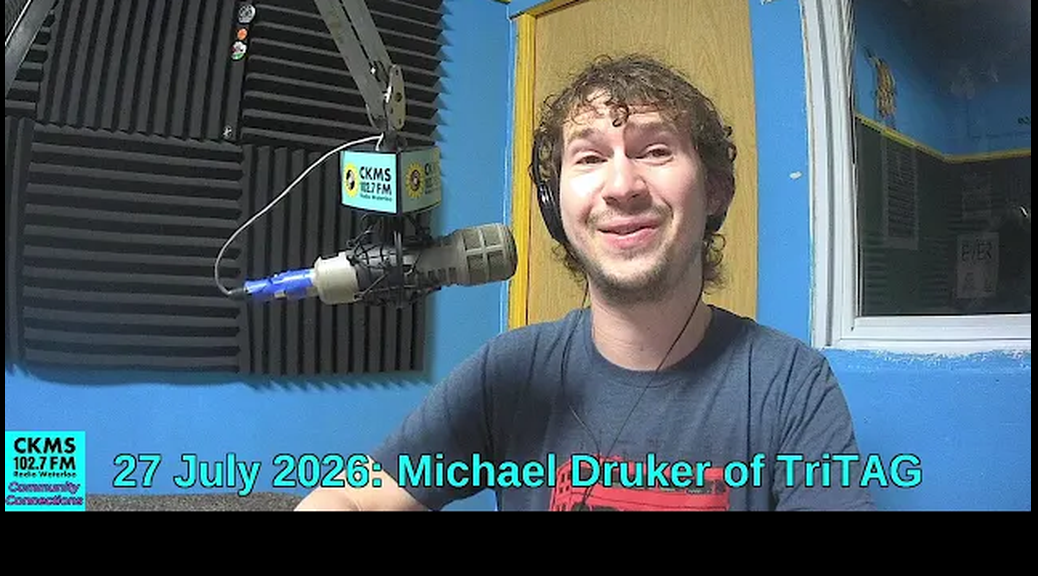
Michael Druker of TriTAG joins Bob Jonkman to talk about all things transport, traffic, and transit. Michael tells Bob about the history and the work that TriTAG does, how TriTAG performs its advocacy, some interesting details on the Light Rail Transit project and Phase Two now being built to Cambridge, how Phase Two can avoid the pitfalls of transit projects in other cities, other projects of TriTAG like the Frequent Transit Network, and the resources available on the TriTAG website.
Michael Druker introduces TriTAG, a local organization that’s been around since 2009, that’s all about people being able to more easily walk, bike, and take transit in Waterloo Region. The advocacy takes place through events, info tables at events, but the focus is on the website, the newsletter, news roundups, and the deep dives they do on policy topics and advocacy focus. There will be an election questionnaire for the upcoming municipal election. Sometimes TriTAG presents at municipal councils, and will sometimes reach out to staff or politicians, but mostly they encourage the public to get in touch with their elected officials.
6m50s
Right now the City of Kitchener is working on their Mobility Master Plan, something where more public input can really make a difference in what gets prioritized. It’s possible to be invested in a policy that’s just not possible due to, for example, budget constraints. Providing positive feedback as well as negative is very valuable; positive voices is something staff and politicians will listen to; they like to know their efforts are appreciated. But it’s easy to take things for granted when they are going well. Is it social media that’s responsible for negativity with council projects? Not just transport but housing and finance. TriTAG can offer a balanced view. It’s not useful to despair or not despair based on the social media algorithms. Michael has not seen a trend, either positive or negative, driven by social media. There are things that capture people’s imagination, in a way that other things don’t, even though they’re important. It depends on how much work is put into public engagement.
12m11s
Introduction to Cold Shoulder by Awake & Dreaming.
Does TriTAG reach out to the province on provincial transporation issues? Not really, most of their advocacy is local.
16m48s
Michael gives some of the history of TriTAG, starting in 2009 with the “Waterloo Region Rapid Transit Project.” Even then, the vision of TriTAG was to give people a choice is choosing their mode of transport: Walking, biking, transit. The issues even extend to land use. TriTAG lost some steam after Light Rail Transit was established in Waterloo Region, but it is now getting a fresh start. Even if transport issues appeas completely solved, there will still be a role for TriTAG. Bases on past performance, there will be lots to do in the future. Even now, there is an approved project for Phase Two of the LRT to Cambridge.
21m30s
The LRT was planned in two phases, there was no way that the entire project could have been funded in one phase. But now that Phase One is done, it does what it was designed to do, and people like it. This matters to people, who want to live next to the LRT. Now we need to bring this to Cambridge, but why stop there? One of the themes in the transit world is the cost of transit construction. When the LRT was proposed, it seemed like a really expensive project, but that was because it seemed unproven. Now that it does work, the cost on a comparative scale was pretty low. That’s not the case in other areas (Toronto’s Eglinton Crosstown LRT, Finch West LRT), and there are knowable reasons for why that happened. We want to take better charge of those reasons when we build Phase Two to Cambridge. If we build cost-effectively, then we can build even more transit infrastructure.
25m56s
What’s the resistance to Phase Two of the LRT? The project is approved, there’s an approved route, although there are some land use questions. Today, the actual barrier is funding — the Region of Waterloo is seeking upper level funding. Bob has heard that costs for Phase Two have ballooned; Michael says that cost estimates have ballooned. The cost estimates have gone up, in part from using the same poor cost practices used in the Toronto LRT projects. But we don’t have to follow the lead of those projects, we can follow the lead of Phase One and build it more cost-effectively. TriTAG hopes that funding can be used for programs that are more than just Phase Two. If we keep building, build in stages, build as we build other infrastructgure, then we keep the knowledge of how to build transit. Michael thinks that the main start will probably be delayed until after the municipal election, but there are other small projects that have prepared for LRT construction.
Other projects TriTAG is working on: “Frequent Transit Network”, already in the business plan for Grand River Transit. Frequent transit is a game changer, at 10-15 minute frequency the service changes qualitatively, people don’t have to allocate time for route planning and waiting for transfers. There are already some frequent routes, the challenge is to add frequency on other routes and to make it consistent, on evenings and weekends. TriTAG has just written an article: Why GRT needs a Frequent Transit Network. People already understand frequent transit from other cities and subway systems. Some people in rural areas would be happy with any transit service at all. Frequent service should be cheap and simple, no additional infrastructure is required, no additional ticketing systems, no new bus stops, only some extra buses and operators. Michael says some routes are already doing frequent service at busy times, although additional bus service will require more maintenance and may wear out the buses faster. But the GRT fleet is fairly new, Michael says buses have a service life of about 14 years. Bob has lived in places where the buses were 20 years old.
44m12s
Talking about the things available on the TriTAG website https://www.tritag.ca/: Newsletters, a weekly news roundup with mobility news, walking, biking, transit, and land use, highlighting what people can get involved in, consultations, feedback, events, plus there are analysis posts, and a series on LRT expansion called IONize Waterloo Region. People can subscribe to the newsletter and news roundup, and follow on the TriTAG social media accounts. Bob mentions an article Kitchener to Stratford by Transit. Michael lists a few other good articles, and reminds us of the upcoming muncipal election.
46m10s
Bob thanks Michael and gives the end credits.
CKMS Community Connections airs on CKMS-FM 102.7 from 3:00pm to 4:00pm on Mondays.
Abby tells us about the Multicultural Festival of Elmira and why it’s not the “Elmira Multicultural Festival” — it’s to avoid acronym confustion with the Elmira Maple Syrup Festival, which has provided support to MFE.
9m19s
Abby tells us about the needs for Equity, Diversity, and Inclusion, and the reasons for H.O.P.E. It is more than just the MFE, and focuses on the rural townships. There has been a lot of acceptance, with more and more people attending their events. Abby, who is a person of colour herself, hasn’t experience racism or exclusion in Elmira, but the Region of Waterloo is rated one of the worst communities for hate crimes. H.O.P.E.‘s approach is to educate about culture. The MFE is the showcase event to make that happen.
Abby tells us of the other activities that are happening at the MFE. There are eight cultures represented in the Cultural Tent. There’s an art project, the mural produced will be exhibited at the Breslau branch of the Region of Waterloo Library. There is Indigenous hair braiding, and a presentation on lacrosse. There are also Mennonite exhibits. And there’s free henna art and face painting.
39m45s
Abby tells us of some of the logistics of planning, which started in January. Telling us how the organization grew. Abby gives contact info on how to get involved. E-mail Abby at acooper@heartsopenforeveryone.ca
Talking about other volunteer opportunities throughout the year, including placement opportunities from Conestoga College. Abby gives a bit more of the support and sponsors for the festival. There are two streams of funding, one for H.O.P.E., the other for MFE.
51m33s
Abby tells us of her plans after the MFE is over: A birthday celebration for her nephew! And there will be other programs, like a Muslim workshop in October/November, talking about hate crimes. In December there is “Holidays With H.O.P.E.“, how different cultures celebrate their holidays. Check the H.O.P.E. website for more upcoming events.
55m30s
Bob gives the end credits.
CKMS Community Connections Hour One airs on CKMS-FM 102.7 on Monday from 11:00am to Noon, and Hour Two airs alternate Fridays from 3:00pm to 4:00pm.
Today Bob plays KW Content music — music by musicians from all over Waterloo Region.
If you’ve made music you want to hear on the radio send it to office@radiowaterloo.ca and we’ll get it on the air. See How To Submit Music for the full details on the format and info we need for music submissions.
 https://run4officewr.ca/




 Subscribe to the CKMS Community Connections podcast!
 See all CKMS Community Connections shows!
 Creative Commons Attribution Only license. Copy, re-use, and derivative works are allowed with attribution to Radio Waterloo and a link to this page. Music selections are copyright by the respective rights holders. The theme music is written and performed by Steven Todd.



 https://heartsopenforeveryone.ca/multicultural-festival-of-elmira/


